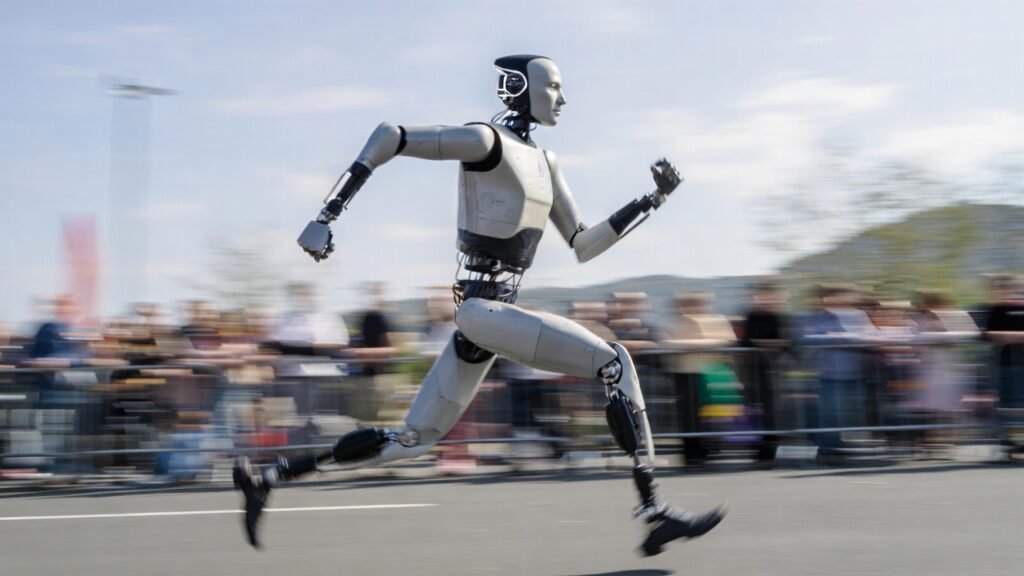
At the 2026 Beijing Half Marathon on April 19th, a humanoid robot record was shattered in the most dramatic way possible — a robot didn’t just finish the race, it demolished every human that ever ran it.
The robot, named Lightning, was developed by Chinese tech company Honor. It completed the 21-kilometer (13.1-mile) course in 50 minutes and 26 seconds — nearly seven full minutes faster than Jacob Kiplimo’s human world record of 57 minutes and 20 seconds.
Let that sink in. Not close. Not almost. Seven full minutes faster.
And furthermore, this wasn’t some lab experiment or controlled test. At the 2026 Beijing Half Marathon, a humanoid robot record was shattered in front of 12,000 human runners. Lightning completed the 21-kilometer course in 50 minutes and 26 seconds. However, the most jaw-dropping part isn’t just the time — it’s how dominant it was. No human has ever come close to that pace.

Humanoid Robot Half Marathon World Record
umanoid robot half marathon world record
What makes this story even more jaw-dropping is how fast the technology is moving.
At the 2025 Beijing Half Marathon, the fastest humanoid robot finished in around two and a half hours. In 2026, the winner crossed the line in under 51 minutes.
That’s not gradual progress. That’s a technological leap in a single year that took human runners decades to achieve.
What the Race Actually Looked Like
The official humanoid robot half marathon world record now stands at 50 minutes and 26 seconds, set by Honor’s Lightning robot in Beijing. To put that in perspective — the human world record held by Jacob Kiplimo is 57 minutes and 20 seconds. A machine just outran the fastest human on earth by nearly seven minutes over 13.1 miles.
This wasn’t a small test event. Over 12,000 human runners and more than 100 humanoid robots competed at the same time — on separate parallel tracks to avoid collisions.
Here’s what stood out:
- Nearly half the robots ran fully autonomously — no human control at all
- Several robots recovered and kept running after collisions
- Robots and humans ran side by side on parallel tracks throughout the full 21km
- Lightning led the robot field from start to finish
The scale of this event is unlike anything the robotics world has seen before.
Why This Matters Beyond Sports
A robot winning a race is a great headline. But what it actually represents is far bigger.
Endurance = real-world capability. Running a half-marathon requires sustained balance, energy management, terrain adaptation, and resilience to unexpected obstacles — like collisions. These are exactly the skills robots need to operate in factories, hospitals, disaster zones, and homes.
The pace of progress is accelerating. A 2.5-hour finish in 2025 to a 50-minute finish in 2026 suggests we are on an exponential curve, not a steady one. If this pace continues, fully autonomous humanoid robots capable of sustained physical work in real environments may arrive sooner than most predictions suggest.
China is leading this race. Honor is a Chinese company, and this event was held in Beijing. The investment in humanoid robotics coming out of China right now is enormous — and results like this are why.
The Robot vs. Human Debate Just Got Real
For years, “robots taking over” has been a tech trope — something to joke about or dismiss. After April 19, 2026, it feels a little less funny.
Lightning didn’t just finish. It won. Decisively.
The humans will keep running their races. But the robots are catching up — and in some cases, they’re already ahead.
What do you think — is this impressive, unsettling, or both? Drop a comment below.