
You’ve heard of ChatGPT. You’ve probably used Claude. Maybe you’ve tried Grok. However, what’s coming next in artificial intelligence makes today’s chatbots look like a warm-up act.
According to a recent Deloitte report, we are entering the era of agentic AI — and furthermore, it reshapes how businesses and individuals operate at a fundamental level. This isn’t about AI answering questions anymore. Instead, it’s about AI running entire workflows, making decisions, and acting autonomously in the real world.
Here’s what that actually means — and why it matters to you.
What Is Agentic AI — And Why Does It Change Everything?
Most people interact with AI as a tool. You ask it something, it responds. Additionally, you might use it to write an email or summarize a document. That’s AI as an assistant.
Agentic AI is fundamentally different. Instead of waiting for instructions, agentic AI systems set goals, create plans, and execute tasks autonomously — without a human approving every step. Furthermore, they can use other tools, browse the web, write code, and interact with external services all on their own.
Think of the difference between asking someone for directions versus handing them your keys and saying “take me there.” That’s the shift happening right now.
Claude, developed by Anthropic, is already moving in this direction. Similarly, OpenAI’s ChatGPT and Elon Musk’s Grok are racing to build agentic capabilities into their platforms. However, the real competition isn’t between chatbots anymore — it’s about who can build the most reliable autonomous AI infrastructure.
Physical AI — When Robots Start Thinking for Themselves

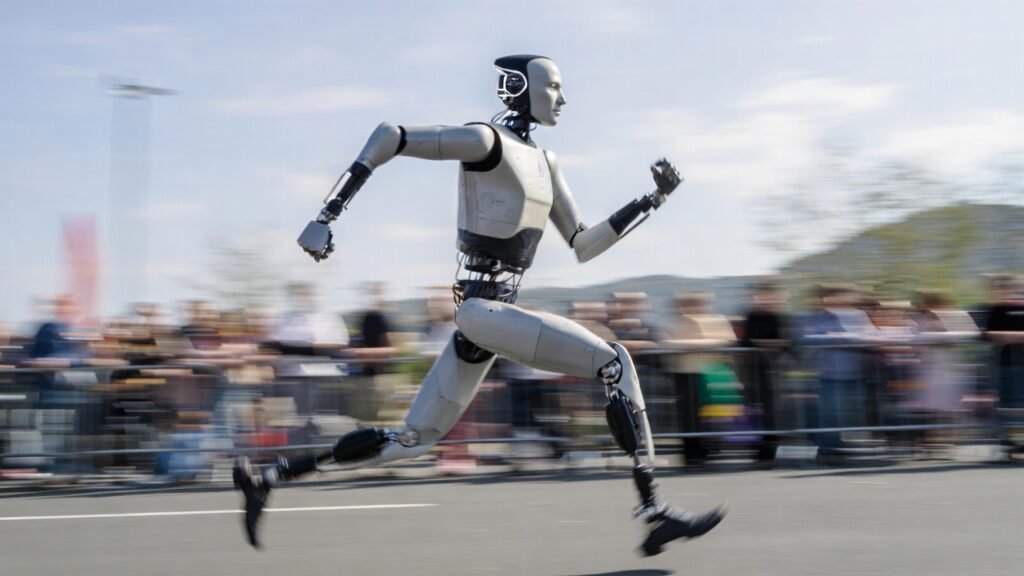
Remember Lightning, the humanoid robot that shattered the half-marathon world record in Beijing last week? That’s physical AI in action.
Moreover, this is one of the fastest-growing areas in the entire tech landscape. Physical AI refers to AI systems embedded in robots and machines that can perceive, reason, and act in the real world — not just on a screen.
Deloitte identifies this as a critical frontier. Additionally, companies like Figure, Boston Dynamics, and Tesla are pouring billions into humanoid robots that can work alongside humans in warehouses, hospitals, and factories. As a result, the line between software intelligence and physical capability is disappearing faster than most experts predicted.
Domain-Specific AI — The End of One-Size-Fits-All Models
For years, the AI race was about building bigger, more general models. However, the smartest companies are now moving in a different direction entirely.
Domain-specific language models are AI systems trained deeply on one field — medicine, law, finance, or engineering — rather than trying to know everything about everything. Furthermore, these specialized models are proving more accurate, more reliable, and more useful in professional settings than general-purpose AI.
In healthcare, for example, AI models trained specifically on medical literature are outperforming general AI on diagnostic tasks. Similarly, legal AI trained on case law is transforming how lawyers research and draft documents. As a result, the future of AI isn’t one giant model — it’s a network of specialized systems working together.
Confidential Computing — The Security Layer AI Desperately Needs

With great AI power comes great responsibility — and significant risk. Nevertheless, this is an area most people overlook entirely.
Confidential computing protects your data while AI processes it. Think of it as a security vault that stays locked even while someone works inside it.. Additionally, as businesses move sensitive operations onto AI platforms, the ability to compute securely without exposing private data becomes essential.
Furthermore, this isn’t just a corporate concern. As AI handles everything from medical records to financial transactions, secure computing infrastructure will determine whether people can actually trust these systems with their most sensitive information.
Cloud 3.0 — AI Infrastructure That Doesn’t Cost the Planet
Building and running massive AI models consumes enormous amounts of energy. However, a new generation of sustainable cloud infrastructure — what Deloitte calls “Cloud 3.0” — is emerging to address this problem.
Engineers build these systems from the ground up for energy efficiency, using renewable power, smarter cooling, and more efficient chips. Additionally, companies like Google, Microsoft, and Amazon are racing to build data centers that can handle the demands of AI at scale without destroying their carbon footprint goals.
As a result, the AI boom and the sustainability push are no longer on a collision course — engineers are making them coexist.
What This Means for You
Here’s the honest summary. AI in 2026 is no longer just about clever chatbots. Furthermore, it’s becoming the operational backbone of how businesses run, how robots move, and how engineers are structuring the internet itself.
Claude, ChatGPT, and Grok are the faces of AI you interact with today. However, the infrastructure companies are building right now — agentic systems, physical AI, confidential computing, sustainable cloud — will determine what AI looks like for the next decade.
Additionally, the shift from “AI adoption” to “AI-driven operations” means one thing clearly: the companies and individuals who understand this transition early will have a significant advantage over those who don’t.
The next wave of AI isn’t coming. It’s already here.
Which of these AI trends are you most excited — or most concerned — about? Drop a comment below.